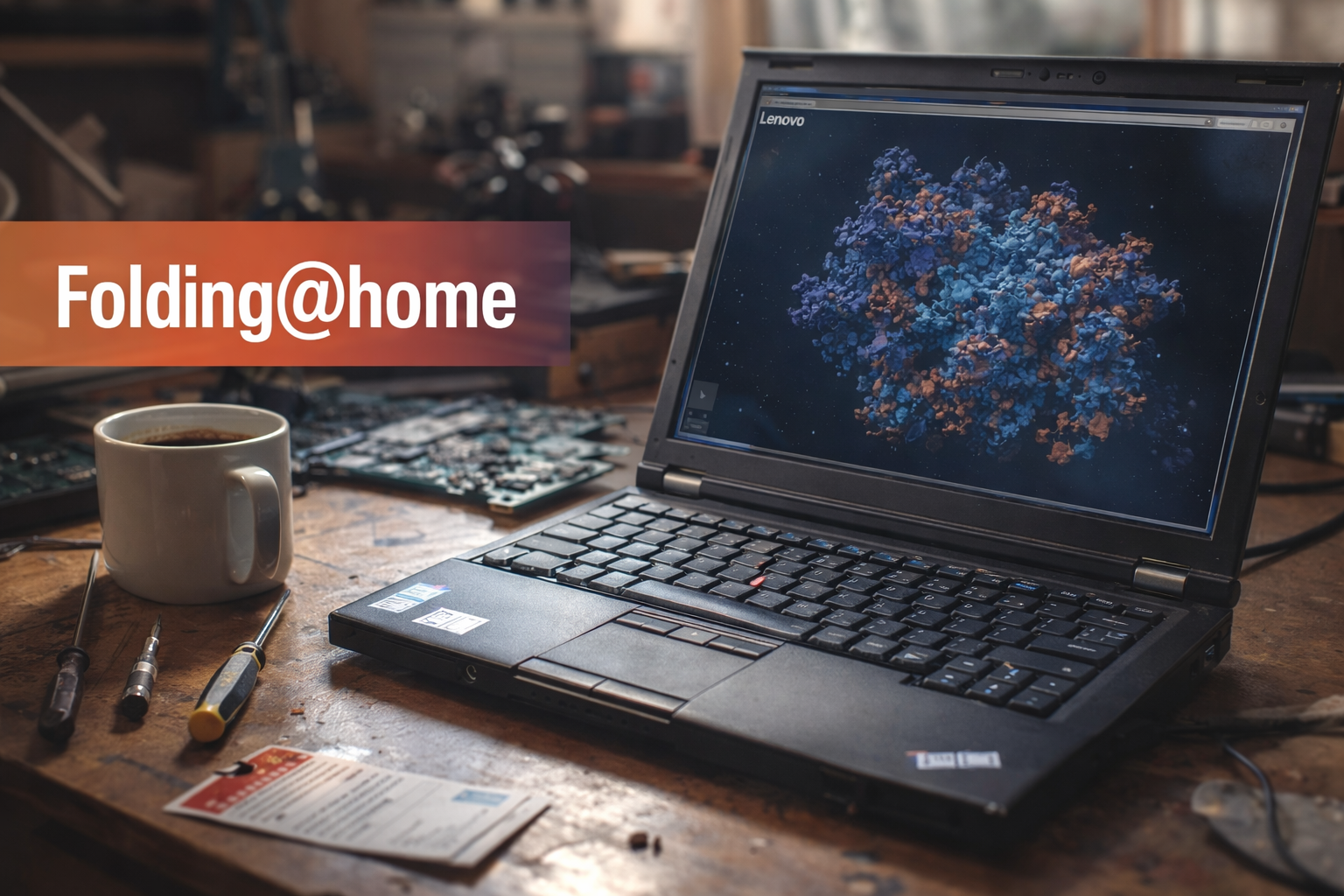
Before crypto, before AI hype, before GPUs became financial instruments, there was a time when spare CPU cycles quietly went to science.
In the early 2000s, whenever I repaired a PC or laptop (which was 99.5% pro bono), I used to do one extra thing:
install Folding@home.
I’d explain to the owner that when their computer was idle, it would donate a tiny bit of electricity and processing power to medical research. Protein folding. Cancer. Alzheimer’s. Real problems. Real science. Electricity was cheap, machines were slow, and nobody expected anything in return – except the quiet satisfaction of contributing.
It wasn’t flashy. There were no tokens, no dashboards promising ROI, no buzzwords. Just a screensaver showing abstract molecules twisting in silence, doing something meaningful while the machine waited.
Fast forward to today. GPUs cost a fortune, watts are measured like fuel, and almost every spare cycle is expected to justify itself financially. And yet… Folding@home is still there. Smaller, quieter, a bit forgotten – but still running. Still doing the work.
I recently stumbled upon my old stats and noticed something funny: I was ranked #1 in my team by points, despite having fewer completed work units. Turns out the system always rewarded impact, not volume. Faster machines, harder simulations, better use of time. That feels oddly consistent with the whole philosophy back then.
No hype. No shortcuts. Just doing the job well.
This isn’t really about idle computing any more.
It’s about a broader shift in mindset.
Back then, the idea that many people could contribute small, invisible pieces toward a shared goal felt natural. There was no expectation of reward, no personal branding, no monetization layer attached to every action. The value was in the collective outcome, not the individual gain.
Today, even our spare resources – time, attention, compute – are framed almost exclusively through profit. If something doesn’t pay, scale, or signal status, it’s often dismissed as naïve or inefficient. In that environment, projects like Folding@home don’t disappear because they stopped mattering, but because the idea of a common, unpaid effort has quietly fallen out of fashion.
Maybe that’s the real loss.
Not idle cycles, but the assumption that doing something together, for no personal return, was once enough.
“As Tolkien wrote, it is often the small, unseen acts of ordinary people that keep the darkness at bay — and perhaps they still can.”